

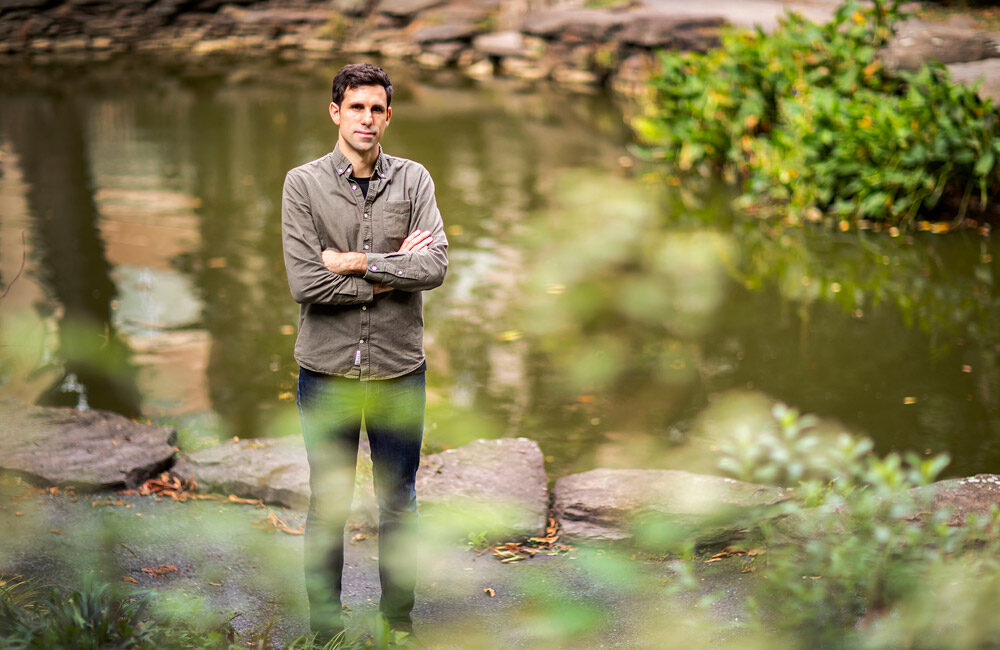
César de la Fuente is a Presidential Associate Professor at the University of Pennsylvania, where he leads the Machine Biology Group. He is one of the youngest tenured professors in the history of Penn Medicine. He completed postdoctoral research at the Massachusetts Institute of Technology (MIT) and earned a PhD from the University of British Columbia (UBC).
His research goal is to use the power of machines to accelerate discoveries in biology and medicine. Notably, he pioneered the development of the first computer-designed antibiotic with efficacy in animal models, demonstrating the application of AI for antibiotic discovery and helping launch this emerging field.
His lab is at the forefront of developing computational methods to mine the world’s biological information, leading to the identification of over a million new antimicrobial compounds. These efforts started by exploring the human proteome as a source of antibiotics for the first time, revealing a previously unrecognized branch of host immunity. His team was also the first to find therapeutic molecules in extinct organisms, launching the field of molecular de-extinction. Molecular de-extinction has already yielded preclinical antibiotic candidates, such as neanderthalin, mammuthusin, and elephasin.
Furthermore, de la Fuente’s lab has broadened its antibiotic discovery initiatives to explore other branches of the tree of life beyond eukaryotes. By computationally analyzing microbial dark matter, his group has identified nearly one million new antibiotic molecules. These molecules have been made freely available and open access to the scientific community to encourage researchers worldwide to synthesize, characterize, and further develop them. This collaborative effort leveraged machine learning to explore the vast diversity of the microbial world by analyzing 63,410 metagenomes and 87,920 microbial genomes. Additionally, through the computational exploration of thousands of human microbiomes, de la Fuente and collaborators discovered a myriad of new antimicrobial agents, including prevotellin-2 produced by the gut microbe Prevotella copri.
Collectively, these efforts have dramatically accelerated antibiotic discovery, reducing the time required to identify preclinical candidates from years (longer than many PhD programs) to just a few hours. It is estimated that the work of de la Fuente and his collaborators has multiplied the speed of antibiotic discovery by a factor of several million, saving many years of human research and reducing what once took decades of collective work to just hours.
Additional advances from his lab include reprogramming venoms into antimicrobials, developing autonomous nanorobots to treat infections, creating novel resistance-proof antimicrobial materials, and inventing rapid, low-cost diagnostic devices for COVID-19 and other infections. Prof. de la Fuente is an NIH MIRA investigator and has received recognition and research funding from numerous organizations.
De la Fuente has received over 80 national and international awards. He is an elected Fellow of the American Institute for Medical and Biological Engineering (AIMBE), becoming one of the youngest ever to be inducted. He was recognized by MIT Technology Review as one of the world’s top innovators for “digitizing evolution to make better antibiotics.” He was selected as the inaugural recipient of the Langer Prize and as an ACS Kavli Emerging Leader in Chemistry, an ASM Distinguished Lecturer, Waksman Foundation Lecturer, and received the Miklós Bodanszky Award, AIChE’s 35 Under 35 Award, Society of Hispanic Professional Engineers Young Investigator Award, and the ACS Infectious Diseases Young Investigator Award. He also received the Thermo Fisher Award, as well as the EMBS Academic Early Career Achievement Award “For the pioneering development of novel antibiotics designed using principles from computation, engineering, and biology.”
Recently, Prof. de la Fuente has been awarded the prestigious Princess of Girona Prize, the ASM Award for Early Career Applied and Biotechnological Research, the ASM Award for Early Career Basic Research, the Rao Makineni Lectureship Award by the American Peptide Society, the Fleming Prize, and was selected as a National Academy of Medicine Emerging Leader in Health and Medicine. De la Fuente has been named a Sloan Fellow for his contributions to the field of chemistry and has been selected by the World Economic Forum to the Young Global Leaders Class of 2025. He serves on the editorial boards of numerous scholarly journals and is currently an Associate Editor of Drug Resistance Updates (IF= 24.3; the premier international drug resistance journal), Nature Communications Biology, Bioactive Materials (IF = 18.9), Bioengineering & Translational Medicine, and Digital Discovery. He has been named a Highly Cited Researcher by Clarivate multiple times.
Prof. de la Fuente has given over 350 invited lectures, including numerous Keynote and Named Lectures, and has also spoken at TEDx. He has co-authored an influential book on machine learning for drug discovery, secured multiple patents, and published over 180 peer-reviewed papers in top-tier journals such as Cell, Science, Cell Host Microbe, Nature Biomedical Engineering, Nature Communications, PNAS, ACS Nano, Nature Chemical Biology, and Advanced Materials.